Our third full day in Beijing started off like the last two with breakfast at the hotel. I bring this up because our hotel offers the best breakfast, including pancakes, pastries and all types of fruits. Its always refreshing to wake up to a good meal, plus it helps provide the well needed enegry for the day's activities.
The first stop we made was to the Alliance Francaise Auditorium, where we heard from a panel of speakers that work in the intellectual property area in China. Our list of speakers included James Luo, Ray Moroney, Eric Priest and David Wolf. The key take ways from this panel discussion included the transformation in IP protection that is occuring in China, the challenges of enforcement and the continuous importance of IP rights for both companies in China and forigen based companies wanting to do business in China. The conclusion was mixed, with some progresses having been achived, whearas the rampant examples of counterfit products shows that there is still a long way to go.
This discussion was an interesting precursor to our next stop of the day, which was to E-Plaza Electronics Mall at Haidian. Having just learned about the rampant counterfit goods (and how often times even the vendors don't know if what they are selling is counterfit) we were a little nervous buying any high-end electronics during our shopping visit. However, it was still fun to see the diffrent stores and try to fact find on what was real and what was counterfit.
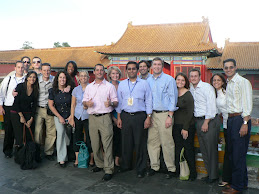
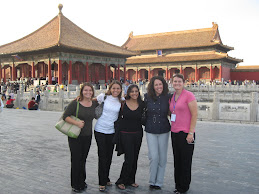
After the shopping visit, we became tourists again, and went to see the sights of Beijing. The Forbidden City is one of the best places we have been able to see thus far. The history of this area dates back to the 15th century and most of the buildings that make up the Forbidden City dated back to this period. I was impressed with how massive the grounds are, covering a large portion of the center of Beijing. After our hour visit, we boarded the buses once again and half of us chose to go back to the hotels while the other half went to a tea ceremony.
The tea ceremony was interesting. We gathered around two tables while one of the servers performed the ceremony, in which she went through several steps in preparing the tea and explaining how women and men hold the tea cup diffrently. Women hold the cup with thier fingers out, while the men do not. Overall, it was a neat experience and provided a great way to see a diffrent side of chinese culture.
If you watched the Olympic coverage on NBC this past summer, you probably saw the clips of The Night Market, where food vendors prepare and sell all sorts of items, including scorpions, beetles and other things that I won't meintion by name on this blog. A few people from the group were daring enough to eat the scorpions. To my knowledge, they are all still okay.
My personal take on the day is that Beijing has a lot of culture to offer. I was speaking with a few of my fellow classmates and it seems that everyone is surprised by how much Beijing has to offer. In addition, I have been impressed with the infrastructure of the city; everything from the subway to the city's skyscrapers are amazing and are all on a scale that is much larger than anything I have seen before. From what I hear, Shanghai is suppose to be even more modern, so I am looking forward to being able to compare the two cities in a few days when we head to Shanghai.
Wednesday, October 15, 2008

Tuesday, October 14, 2008
This morning we started off having some free time, where diffrent groups chose to go for a morning walk through a near-by park, visit shopping districts or catch up on sleep. After the free time, everyone gathered back at the hotel to hear Mr Bai Chengyu, Secretary General of China Association of MicroFinance talk about how his organization has been investing in private businesses that otherwise would not have access to traditional banking services. The major topic discussed was how microfinancing is helping alleviate poverty in China, and he provided the group several examples of sucess stories that he has seen through microfinancing.
The afternoon session included additional speakers, but this time we were able to go off location from the hotel and visited the American Club, which was about a 10 min bus ride. The club provided a great view of the city, and for the first time I realized how big a city we are in. One could hundreds of skyscrapers lining the surronding area for as far as the horizon.
At the American club we had three speakers, all of which I really enjoyed. The first up was James (Jim)McGregor, who was the previous CEO of Dow Jones & Company in China and the bureau chief for The Wall Street Journal in China and Taiwan. Currently Mr. McGregor is the CEO of his JL McGregor & Company and also writes books, such as One Billion Customers: Lessons from the Front Lines of Doing Business in China. Jim McGregor spoke to us on a range of topics, including his personal experiences in China over the past several decades to how the current financial crisis is impacting the role that China plays on the world economy.
Second up was Joe Tavares, Vice President of Business Development & Customer Hospitality UPS Beijing. Mr. Tavares was a dynamic speaker who outlined UPS's strategy of being a sponsor of the Olpymic Games in Beijing. I had not realized that prior to the games, UPS had a small presence in China. Joe outlined for us how the Olympics has allowed UPS to further develop their presence in this market. If you watched the Olympics this past summer, there is a good chance that you saw many of the items that UPS shipped and stored both during and after the games. All the uniforms that were used in the opening and closing cermonies were shipping in by UPS. In addition, the majority of the logistics was provided by UPS. Joe's personal role in all of this was overseeing the negotiation, development and execution of many of the business development initiatives including service contracts with the Organizing Committee for the Games of the XXiX Olympiad ("BOCOG"), the Intermational Olympic Committee and all other Olympic Family members, Olympic sponsors and suppliers.
Last up was Chris Renner, a ND alum and the President of Helios Partners in China. Mr. Renner also played a big part in the Olympics, where from May 2006 he has overseen his own Beijing-based consulting agency, which specializes in providing strategic sports marketing expertise to major companies like Coca-Cola, Addidas and Johnson & Johnson. Joe is no strager to the Olympics, where he has worked on past games since 1992. The major take-away from Mr. Renner's discussion was the fact that some companies, like Coca-Cola were able to launch a successful marketing platform during the games, where other companies fell short of making much of an impact through their sponsorship attempts. It was interesting hearing how complex it is for companies to make an impact, and the various steps that each company takes to make sure they are providing and capturing the most value possible. Creativity is key within this area, and Chris discussed how companies that were able to connect with the Chinese population were most sucessful in building their brands.
After the speakers at the American Club, we boarded back on the buses and made our way to Xiao Wang Fu Restaurant for a group dinner. The food was excellent and we were provided a variety of dishes including fried rice and Peking Duck.
That sums up most of the day. Yesterday I promised to upload some pictures which I am still working on, so hopefully I can have those up soon to show you more of the city and the various sites we have been able to visit.
Monday, October 13, 2008
We're in China!
We're in China! Our group arrived around 11 o'clock last night, and despite the length of the journey, the trip was actually not too bad. Once we arrived in Beijing, I was very surprised how easy the customs process was and how quickly we were able to get our bags. Once we had everything, we proceded outside, where we were greeted by a University of Notre Dame sign that pointed toward our bus to the hotel, The Grand Milennium in the Chaoyang District.
I must say, our hotel is awesome. Not only is it located in one of the nicest areas of Beijing, it has every gadget you can imagine, including power window shades, a flat screen tv and this computer that I am typing on right now!
After a good nights sleep, we were back on the buses, ready for our first trip of the day. The first stop was the Great Wall of China. According to our tour guide, there are three main areas that tourists go to see the Great Wall in Beijing. We went to the site in Mutianyu, which is about a 1/2 hour drive from our hotel. I did not know what to expect (beside what I had seen on tv), but found myself amazed at how massive the structure is up close. To get to the top, we rode a sky bucket which flew us up the mountian side to one of the wall's towers. Once at the wall, we were able to walk along the structure, going between the diffrent towers.
We had about an hour to explore the area, then loaded back ont the bus for a trip back to the hotel to meet with our first speaker, James Hexter, Senior Partner at McKinsey & Company in China. Some of the key take aways from this discussion include the transformation China is experiencing and how that momentum is to look going forward. At the end of the presentation, students were able to ask questions about sustainability, leadership structures in Chinese management and a host of other questions. Mr. Hexter was able to draw upon his years working in China, as well as the research he has conducted as a writer.
After our meeting with James Hexter, we were able to see some more of ancient China, including the Temple of Heaven. Built in 1420, this area was used by the Emperor for seasonal sacrifices to the gods. At the center of the grounds, there is a circle where it is believed that those who stand on it will be able to absorb the energy of the place, so it was comical to see everyone trying to push their way to the middle of the spot.
Our last stop of the day was to the shopping district, where we were able to buy everything from pearls to leather bags. Negoiation was key in this market, and often times we were able to talk the vendors down to 40% of the orginal asking price. I was able to pick up a new suitcase, which will come in handy as we visit more shops during the visit.
I think that pretty much covers the main things that we were able to experience today. Tomorrow I will try to upload some pictures to give you a better perspective.
Saturday, October 11, 2008
On our way to China
Welcome to the University of Notre Dame MBA Fall 2008 China Trip Blog! Over the next few weeks, I will be keeping you up-to-date with our journeys throughout Beijing and Shanghai, so be sure to check out this blog frequently to see the new posts.
Today we are about to board several planes and start our trip towards Asia. The route my group is taking includes South Bend--> Detroit --> Tokyo and finally Beijing. Going toward Asia, we’ll actually lose a day, so even though we depart on a Saturday morning, we won’t arrive in the Beijing airport until Sunday evening. It’s going to be a long trip, so I’m glad I purchased that travel pillow!
On the next post, I’ll let you know how the trip went and what it was like to arrive in China!
Subscribe to:
Posts (Atom)